Showing posts with label Winter. Show all posts

Saturday, May 9, 2009

Saturday Something - Summertime Moon and Astrology Gardening

Summertime Moon and Astrology Gardening
by Ravenna Morgan

The Moon's magnetic force pulls all that contains water: the tides of our oceans, the blood and fluids of our bodies, and all plant life - it lets you know when to sow, when to gather, and when to weed. By learning to flow with the rhythm of the Goddess we are ensuring the best crops, herbs and flowers and this in turn will resonate within us to create a connection with Mother Earth such as we have never known before, it will enrich us spiritually, emotionally, physically and mentally.

The Moon travels through each one of the Zodiac signs about once a month - she stays in one sign about 2 1/2 days before moving on to the next one. It's never wise to plant on the day of the New Moon or Full Moon. The waxing and waning process of the moon can be divided into the four phases of new moon, first quarter moon, full moon, and last quarter moon. In each phase, certain plants have the best chances for growth.

A moon that is waxing increases in light from a new moon to a full moon. A waxing moon, which is increasing in light, will be beneficial for plants growing above the ground. The first week is especially good for crops that have their seeds on the outside, such as asparagus, broccoli, celery, cabbage and spinach. The second week (between the 1st quarter and the Full Moon) is best for crops that produce seeds on the inside, like peppers, tomatoes, peaches, cucumbers and melons.

A moon that is waning decreases in light from a full moon until the next new moon. Plant root crops such as potatoes, peanuts, carrots and onions, bulbs, perennials, and biennial plants during a waning moon. Harvesting also should be done during a waning moon. To encourage your lawn to grow fast, cut it during new or first quarter moon. To encourage it to grow more slowly, cut it during a full or last quarter moon.

Charts are available that tell you what phase and what Zodiac sign the Moon is in at any given time. The following is a guide. Planting & Garden Care by the Zodiac:

Aries is a dry & barren time; plant onions, hot peppers & garlic, kill weeds deter unwanted insects.

Taurus is a moist and productive time; plant root crops such as turnips, potatoes, carrots.

Gemini is a dry and barren time - a good time to pinch tips from plants to stop unwanted growth, fork up and aerate the soil, pull weeds.

Cancer is the most moist and fertile time of all. Watch those seeds germinate! Time to irrigate, to graft, and to transplant new seedlings.

Leo is the driest and most barren time. No planting, pruning of vines or trees should be done. This is the best time to kill weeds and deter unwanted insects.

Virgo is a moist, but barren time, a time to weed, tie up vines, clean your garden tools and do all the garden maintenance jobs that have been waiting.

Libra is a moist and reasonably productive time, good for planting ornamental flowers or sowing flower seeds.

Scorpio is a very moist and productive time. This is the best time for fertilizing your garden; good for planting too - especially vines.

Sagittarius is a dry and barren time - this is not the time to plant or prune.

Capricorn is a reasonably productive time and is good for planting root crops such as carrots and potatoes.

Aquarius is a dry & barren time, no good for planting, but take the time to rake the soil and get rid of weeds.

Pisces is a moist and very productive time, excellent for the growth of fruits and berries, and to fertilize the garden. Good for short, quick growth and deep roots, and for planting bulbs.

Copyright Ó Nerys Purchon (AKA Ravenna Morgan). Permission is granted to share this article with others, provided you do so in it's entirety and include this copyright statement.

Disclaimer: No one involved in this blog or its contents may be held responsible for any adverse reactions arising from following any of the instructions/recipes on this list. It is the reader's personal responsibility to exercise all precautions and use his or her own discretion if following any instructions or advice from `this blog.

Tuesday, February 3, 2009

Tuesday Try A New Taste – Chicken Barley Stew With Herbs

Yes, I know Beltane is fast approaching, and Spring is on the way. But I am looking at my window at the new 2” of snow that’s falling as we speak. erm….type. Spring may be on the way, but Winter has yet to even consider allowing her access! So, with that in mind, and  since I think stew is one of the best cold weather foods ever created, here is today’s recipe..

bb

tag.winter.0002

* Chicken Barley Stew With Herbs *
from
Red Deer & Elenya's

Comment: This is originally an Anglo-Saxon recipe. The original calls for rabbit, but chicken is just as good.

Ingredients:

  • 2-3 lb chicken breasts on the bone
  • 2 Tbsp butter
  • 1 lb leeks (3-4 large ones, 4-5 little ones) thickly cut. May substitute onions
  • 4 cloves garlic, chopped fine
  • 6 oz barley
  • 3 Tbsp red wine vinegar
  • 3 3/4 cups water
  • 2 bay leaves
  • 1 Tbsp dried sage

In a large dutch oven, melt the butter, then sauté`e the leeks and garlic in the butter. Add the chicken and brown. Add remaining ingredients, reserving the sage. Bring to a boil, then reduce and simmer for 1 to 1-1/2 hours. Remove chicken from pot and let cool. Remove meat from bones and add back to the pot. Add sage. Stir well and serve. Leftovers freeze well. Serves 8.

And what is stew without bread..?

* Irish Soda Bread *
The link I had for this no longer works :(

Ingredients:

  • 1 1/2 cups All-purpose flour -- unbleached, enriched
  • 1 1/2 cups Whole wheat flour -- stone-ground
  • 1/4 teaspoon Kosher salt
  • 1/2 teaspoon Baking soda
  • 1 1/4 cups Buttermilk

Set the baking rack in the center of the oven and place a baking stone (if available) on the rack. Preheat the oven to 375. In a mixing bowl, combine the dry ingredients. Combine thoroughly. Make a well in the center of the dry ingredients and add the buttermilk. Mix quickly to blend the milk evenly. It may be easier to mix with the hands than with a spoon. Form the dough into a loaf shape and place in a nonstick 8 1/2-x 4 1/2 x 2 1/2" loaf pan. Place in the preheated oven and bake for 50-55 minutes, until well browned and a skewer inserted in the center comes out dry. Remove from the oven and the baking pan. Place on a wire rack to cool.

Disclaimer: No one involved in this blog or its contents may be held responsible for any adverse reactions arising from following any of the instructions / recipes on this list. It is the reader's personal responsibility to exercise all precautions and use his or her own discretion if following any instructions or advice from this blog.

Tuesday, December 30, 2008

Tuesday Try A New Taste – Pasta With Smoked Cheese

* Pasta with Smoked Cheese *
Found at
ABI


Ingredients:

  • 1/4 cup (1/2 stick) butter
  • 1 1/2 cups broccoli florets
  • 1 cup sliced fresh mushrooms
  • 2/3 cup julienne-cut raw, peeled sweet potato
  • 3 tablespoons chopped shallots
  • 2 tablespoons chopped fresh oregano OR 1 teaspoon dried oregano, crushed
  • 1 cup whipping cream
  • 1/8 teaspoon pepper
  • 8 ounces dry fettuccine noodles or whole wheat fettuccine noodles
  • 1/2 cup roasted red bell pepper strips
  • 1 1/2 cups (6 ounces) shredded smoked Gouda cheese
  • 1/4 cup coarsely chopped walnuts

Melt butter in large skillet. Add broccoli, mushrooms, sweet potato, shallots and oregano. Sauté about 8 minutes or until vegetables are crisp-tender. Stir in whipping cream and pepper. Bring to a boil; reduce heat and simmer to reduce cream slightly, stirring constantly. (Cream should cling to vegetables.) Meanwhile, cook noodles according to package directions; drain. Add cooked noodles to vegetable mixture; toss gently to combine. Stir in roasted pepper strips. Sprinkle with cheese and walnuts. Serve immediately.
***Perfect Pasta Hint: Improve your pasta dishes simply by adding a pat of butter to the pasta just after it's drained. Not only will this give your sauce extra body and flavor, but it will also help the sauce adhere to the pasta.

Yield: 6 servings.

Disclaimer: No one involved in this blog or its contents may be held responsible for any adverse reactions arising from following any of the instructions/recipes on this list. It is the reader's personal responsibility to exercise all precautions and use his or her own discretion if following any instructions or advice from this blog.

Monday, December 29, 2008

Monday Make A – Snowman Wind Chime & Pine Cone Bird Feeder

* Snowman Wind Chime*
posted by Susie

You will need:

  • 4" ceramic clay pot
  • 4" Styrofoam ball
  • 36" long 1" diameter plastic candy cane
  • lg felt snowman hat
  • wooden carrot (for nose)
  • 2 buttons (5-1/2" and 2-1")
  • 1 jar decoart snow tex
  • white acrylic paint
  • green felt square
  • 3 large bells
  • 2 yard jute
  • plastic holly blush
  • scissors
  • xacto knife
  • flat paintbrush
  • hot glue gun and sticks
  • craft stick ruler

Add some acrylic paint to the snow tex jar. Use craft stick to stir until consistency of paint. Cover the entire pot with mixture, let dry. Cover the Styrofoam ball with the mixture, let dry. Use knife to cut candy cane into 3 equal lengths to use as chimes. Cut 3 12" pieces of jute and tie a bell to the end of each piece. Gather ends of jutes (the bell less ends) making sure chimes hang at different lengths. Thread through the hole in the bottom of the pot and knot. Glue to secure knot and trim off excess jute. Glue Styrofoam ball to the top of pot to form the head of the snowman. Cut 2, 12" x 2" strips of felt, glue ends together to make one long strip. Make 2" cuts along each end to make fringe. Wrap scarf around neck of snowman and glue to secure. Glue the 1/2" buttons on the face (2 for the eyes and 3 for the mouth). Glue the carrot nose on. Glue the 1" buttons down the front of the pot for buttons. Cut a 12" piece of jute and knot the ends together. Use the scissors to make a small hole in the top of the Styrofoam ball. Push the jute knot into the hole and glue to secure as a hanger. Use the scissors to make a small slit in the top of the hat. Thread the hanger up through the slit and glue the hat to the foam ball. Add blush to cheeks and glue the holly onto the scarf.

* Pine Cone Bird Feeders *
Posted by Susie

You will need:

  • Pine cone
  • yarn
  • peanut butter
  • bird seed

This is a really easy one for little kiddies. Take your pine cone and tie a strong piece of yarn around the base of it. Cover the pine cone with peanut butter. Roll the pine cone in bird seed and hang from a branch outside. You can put more PB and seeds on it when the birds finish it. Try different seeds to attract different types of birds.

Disclaimer: No one involved in this blog or its contents may be held responsible for any adverse reactions arising from following any of the instructions/recipes on this list. It is the reader's personal responsibility to exercise all precautions and use his or her own discretion if following any instructions or advice from this blog.

Thursday, December 25, 2008

Bonus Post *Christmas & Winter Superstitions, Folklore & Weather lore***

* Christmas Superstitions *
source unknown

~ Snow on Christmas means Easter will be green.

~ A blowing wind on Christmas Day brings good luck.

~ Wearing new shoes on Christmas Day will bring bad luck.

~ The child born on Christmas Day will have a special fortune.

~ Place shoes side by side on Christmas Eve to prevent a quarreling family.

~ To have good health throughout the next year, eat an apple at midnight on Christmas Eve.

~ A clear star-filled sky on Christmas Eve will bring good crops in the summer.

~ Eat plum pudding on Christmas and avoid losing a friend before next Christmas.

~ On Christmas Eve all animals can speak. However, it is bad luck to test this superstition.

~ If you refuse a mince pie at Christmas dinner, you will have bad luck for the coming day.

~ Good luck will come to the home where a fire is kept burning throughout the Christmas season.

~ In Greece, some people burn their old shoes during the Christmas season to prevent misfortunes in the coming year.

~ In Devonshire, England, a girl raps at the henhouse door on Christmas Eve. If a rooster crows, she will marry within the year.

~ One must begin decorating one's house with a wreath on the front door, with no decorating to have been done before that. After the wreath is in place, the rest of the house should be decorated, working in from the front door. The wreath placed on the front door at the start will guarantee nothing but good energy enters the house, and the energy will follow the decorations within, leading into the heart of the home. The reverse is also true; the wreath should always be taken down last when removing holiday decorations.

CHRISTMAS_WITCH


* Winter Weather Forecasting by Woolly Worms *

by Old Wives Tales

People in many areas know that autumn has arrived when they start spotting woolly worms. One of the enduring folk tales in the United States is that a woolly worm can share insight about the upcoming winter's weather. Is there a grain of truth in this belief? First off, we need to establish what is a woolly worm. You may have also heard them called woolly bears.

Woolly worm is a common name for the larval [caterpillar] stage of a family of tiger moths. If you want to get technical, the scientific name is Pyrrhactia. Woolly worms generally are from 1 to 3 inches long and found throughout the United States. This may explain why belief in their winter prediction ability is widespread.

The woolly worms of winter weather forecasting fame are not just any ol' Pyrrhactia family member. You want to seek out the Pyrrhactia Isabella [Isabella tiger moth]! This is the woolly worm which is densely covered with bristly hair that is black at both ends of the body and light reddish-brown in the middle. The predictive area you want to observe is the brown band portion: The narrower the band, the harsher the winter. If more brown than black and the middle band leans toward orange, that indicates the winter will be mild.

As widely shared as that bit of folk lore is within the United States, experts will say that the belief is simply not true. The variations in a woolly worm's bands are due to other factors and not weatherly predictive powers. In other words, the scientific evidence does not help support that particular weather lore.

For example, the bands vary due to differences in species. The particular genus [Pyrrhactia] contains around eight different species whose larva will parade in the fall months with fashionable bristly haired coats. Some are solid black, without any bands, and others have bands of varying sizes. Yet I already shared earlier in this article that you wanted the Pyrrhactia Isabella due to the type of banding on that particular species. So could this mean the scientists think that people will easily confuse what caterpillar, out of that particular family, that they need to observe? In a way but there are other reasons they will share.

The size of bands is also be due to the stage of growth the woolly worm is in and not the weather predictions being shared. A woolly worm has six larval stages before entering the winter cocoon stage. What this means is that the caterpillar sheds its former coat, or molts, six times and this process can have the color and size of the bands vary from molt to molt. For example, older caterpillars may have more black than younger ones.

There are some year-to-year weather factors that can help determine the amount of black hair on banded woolly worms. Now don't let that get your hopes up that this is where the predictive ability of the woolly worm may come into play. Ones that ate and grew in an area where the fall weather was wetter generally have more black hair than the woolly worms from drier areas. So in essence, according the scientific community, the woolly worm cannot be fully counted on to provide an accurate peek at the upcoming winter. It may instead hint about growing in an area where the weather had been a damp or that it is getting ready to enter the pupal stage.

However, just because I shared a view point that woolly worms weather forecasting skills are more lore than fact does not mean you cannot have fun appreciating the little critter or the folk lore associated to it. Every October the town of Banner Elk in North Carolina holds a Woolly Worm Festival! The town boasts that, over the past 20 years, their "Woolly Worm Readers" have had an accuracy rate of nearly 90%. What's the secret of their accuracy? Well, first off they have to know which woolly worm to use.

And I do not mean they just rely on making sure that they have the larval Isabella tiger moth either. They host a woolly worm race where the caterpillars race upwards on strings that are three feet long. It may be an edge to train your woolly worm for this competition. However, there isn't a prerequisite that you have come to the festival with your own woolly worm for this racing event. You can try your luck by selecting a particularly speedy looking woolly worm to purchase from one of the local children.

The woolly worm that becomes champion of the Woolly Worm Race is then used by festival's "Woolly Worm Readers" to determine the official Woolly Worm Forecast for winter! If that isn't honor enough, the woolly worm's owner will also win a cash prize! [For more information, contact: Woolly Worm Festival,
PO Box 3335,
Banner Elk, NC 28604
Phone: (828) 898-5605].

References:
The Official Site of The Wooly Worm Festival 

University of Illinois at Urban – Champaign

Iowa State University Entomology Department
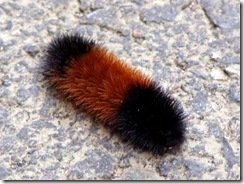
Wooly

* Folklore and Weather lore of Winter *

Source Unknown or Unavailable

~ Count each foggy day in August, there will be a snowfall for each.

~ If July is hot & August is exceptionally cool, it will bring a hard winter with little snow.

~ A windy December is indicated by a rainy March.

~ If October is overly warm, February will be exceptionally cold

~ If October’s full moon arrives without a frost, there won’t be front until after November’s full moon.

~ The severity of Winter can be foretold by how close to Christmas Day the new moon falls – the closer it is, the harder the Winter to come.

~ If Autumn flowers bloom late, the Winter will be bad.

~ If in August the first week is exceptionally warm, the following Winter will be very long, and bring heavy snows.

~ Expect a bad Winter if November is overly warm.

~ Watch the growth of the weeds – their height indicates how high the snow banks will be.

~ If the leaves drop early in the season, it indicates winter will be mild, however, if the leaves drop late, winter will be nasty

~ A cold Winter is indicated by thunder in the Fall.

~ Thunder during the week of Christmas foretells a rough Winter.

~ If Christmas is green, Easter will be white

~ Onion skins are an indicator of the coming Winter – if thin, the Winter will be mild, if thick & tough, Winter will be long & hard

~ Look to other fruits & vegetables , as well as wildlife for signs – thick cornhusks, tough apple skins, plentiful nuts & berries, early migration of birds, bees building very high in trees – all indications to prepare for a bad Winter.

~ If ant hills are high in July, the Winter will have lots of snow.

~ Squirrels scurrying to gather nuts indicates a fast, heavy snowfall is on the way. Holding their tails high is another indication of a long Winter.

~ Look at the breast of your Thanksgiving goose (turkey maybe..? not sure on this one…) lots of spots indicate long, cold Winter, few  spots indicates a mild Winter.

~ Have access to a partridge (not necessarily in a pear tree…)? Look at the feathers on it’s legs. The farther down they’ve grown, the more severe the Winter to come.

~ A wide brown band on a woolly bear caterpillar, says it will be a mild Winter.

~ The first snowfall coming before the ground has frozen hard indicates a mild Winter.

winter56blank

Disclaimer: No one involved in this blog or its contents may be held responsible for any adverse reactions arising from following any of the instructions/recipes on this list. It is the reader's personal responsibility to exercise all precautions and use his or her own discretion if following any instructions or advice from this blog.