* Lammas: The First Harvest * by Mike Nichols at The Witches' Sabbats
It was upon a Lammas Night
When corn rigs are bonny,
Beneath the Moon's unclouded light,
I held awhile to Annie...
Although in the heat of a Mid-western summer it might be difficult to discern, the festival of Lammas (Aug 1st) marks the end of summer and the beginning of fall. The days now grow visibly shorter and by the time we've reached autumn's end (Oct 31st), we will have run the gamut of temperature from the heat of August to the cold and (sometimes) snow of November. And in the midst of it, a perfect Mid-western autumn.
The history of Lammas is as convoluted as all the rest of the old folk holidays. It is of course a cross-quarter day, one of the four High Holidays or Greater Sabbats of Witchcraft, occurring 1/4 of a year after Beltane. It's true astrological point is 15 degrees Leo, but tradition has set August 1st as the day Lammas is typically celebrated. The celebration proper would begin on sundown of the previous evening, our July 31st, since the Celts reckon their days from sundown to sundown.
However, British Witches often refer to the astrological date of Aug 6th as Old Lammas, and folklorists call it Lammas O.S. ('Old Style'). This date has long been considered a 'power point' of the Zodiac, and is symbolized by the Lion, one of the 'tetramorph' figures found on the Tarot cards, the World and the Wheel of Fortune (the other three figures being the Bull, the Eagle, and the Spirit). Astrologers know these four figures as the symbols of the four 'fixed' signs of the Zodiac, and these naturally align with the four Great Sabbats of Witchcraft. Christians have adopted the same iconography to represent the four gospel-writers.
'Lammas' was the medieval Christian name for the holiday and it means 'loaf-mass', for this was the day on which loaves of bread were baked from the first grain harvest and laid on the church altars as offerings. It was a day representative of 'first fruits' and early harvest. In Irish Gaelic, the feast was referred to as 'Lugnasadh', a feast to commemorate the funeral games of the Irish sun-god Lugh. However, there is some confusion on this point. Although at first glance, it may seem that we are celebrating the death of Lugh, the god of light does not really die (mythically) until the autumnal equinox. And indeed, if we read the Irish myths closer, we discover that it is not Lugh's death that is being celebrated, but the funeral games which Lugh hosted to commemorate the death of his foster-mother, Taillte. That is why the Lugnasadh celebrations in Ireland are often called the 'Tailltean Games'.
The time went by with careless heed
Between the late and early,
With small persuasion she agreed
To see me through the barley...
One common feature of the Games were the 'Tailltean marriages', a rather informal marriage that lasted for only 'a year and a day' or until next Lammas. At that time, the couple could decide to continue the arrangement if it pleased them, or to stand back to back and walk away from one another, thus bringing the Tailltean marriage to a formal close. Such trial marriages (obviously related to the Wiccan 'Handfasting') were quite common even into the 1500's, although it was something one 'didn't bother the parish priest about'. Indeed, such ceremonies were usually solemnized by a poet, bard, or shanachie (or, it may be guessed, by a priest or priestess of the Old Religion).
Lammastide was also the traditional time of year for craft festivals. The medieval guilds would create elaborate displays of their wares, decorating their shops and themselves in bright colors and ribbons, marching in parades, and performing strange, ceremonial plays and dances for the entranced onlookers. The atmosphere must have been quite similar to our modern-day Renaissance Festivals, such as the one celebrated in near-by Bonner Springs, Kansas, each fall. A ceremonial highlight of such festivals was the 'Catherine wheel'. Although the Roman Church moved St. Catherine's feast day all around the calendar with bewildering frequency, it's most popular date was Lammas. (They also kept trying to expel this much-loved saint from the ranks of the blessed because she was mythical rather than historical, and because her worship gave rise to the heretical sect known as the Cathari.) At any rate, a large wagon wheel was taken to the top of a near-by hill, covered with tar, set aflame, and ceremoniously rolled down the hill. Some mythologists see in this ritual the remnants of a Pagan rite symbolizing the end of summer, the flaming disk representing the sun-god in his decline. And just as the sun king has now reached the autumn of his years, his rival or dark self has just reached puberty.
Many commentators have bewailed the fact that traditional Gardnerian and Alexandrian Books of Shadows say very little about the holiday of Lammas, stating only that poles should be ridden and a circle dance performed. This seems strange, for Lammas is a holiday of rich mythic and cultural associations, providing endless resources for liturgical celebration.
Corn rigs and barley rigs,
Corn rigs are bonny!
I'll not forget that happy night
Among the rigs with Annie!
-- Verse quotations by Robert Burns, as handed down through several Books of Shadows.
(Document Copyright © 1986, 1998 by Mike Nichols. This document can be re-published only as long as no information is lost or changed, credit is given to the author, and it is provided or used without cost to others.)
* Lughnassadh (Lammas) and Its Lore *
By StormWing, From CAULDRONS AND BROOMSTICKS LAMMAS issue 1999,
Lughnassadh (pronounced "LOO-nahs-ah") or Lammas, is one of the Greater Wiccan Sabbats and is usually celebrated on August 1st or 2nd, although occasionally on July 31st. The Celtic festival held in honor of the Sun God Lugh (pronounced "Loo") is traditionally held on August 7th. Some Pagans celebrate this holiday on the first Full Moon in Leo. Other names for this Sabbat include the First Harvest Festival, the Sabbat of First Fruits, August Eve, Lammastide, Harvest Home, Ceresalia (Ancient Roman in honor of the Grain Goddess Ceres), Feast of Bread, Sabbat of First Fruits, Festival of Green Corn (Native American), Feast of Cardenas, Cornucopia (Strega), and Thingtide. Lughnassadh is named for the Irish Sun God Lugh, although the most commonly used name for this Sabbat is Lammas, an Anglo-Saxon word meaning "loaf-mass".
The Lughnassadh Sabbat is a time to celebrate the first of three harvest celebrations in Witchcraft. It marks the middle of Summer and represents the start of the harvest cycle and relies on the early crops of ripening grain. It is therefore greatly associated with bread as grain is one of the first crops to be harvested. Wiccans give thanks and honor to all Gods and Goddesses of the Harvest, as well as those who represent Death and Resurrection.
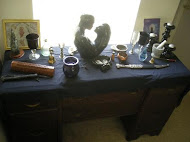
Symbols to represent the Lammas Sabbat include corn, all grains, corn dollies, sun wheels, special loaves of bread, wheat, harvesting (threshing) tools and the Full Moon. Altar decorations might include corn dollies and/or kirn babies (corn cob dolls) to symbolize the Mother Goddess of the Harvest. Other appropriate decorations include Summer flowers and grains. You might also wish to have a loaf of whole cracked wheat or multi-grain bread upon the altar.
Deities associated with Lughnassadh are all Grain and Agriculture Deities, Sun Gods, Mother Goddesses and Father Gods. Particular emphasis is placed on Lugh, Demeter, Ceres, the Corn Mother and John Barleycorn (the personification of malt liquor). Key actions associated with Lammas are receiving and harvesting, honoring the Parent Deities, honoring the Sun Gods and Goddesses, as well as celebration of the First Harvest.
You can create a Solar Wheel or a Corn Man Wheel using a wire coat hanger, cardboard, and several ears of Indian corn complete with the husks. Here is how: bend the wire hanger into a circle keeping the hook to hang it by. Cut out a small cardboard circle to glue the tips of the ears of corn onto. You may want to create your Corn Man Wheel as a pentagram using five ears, or a Solar Wheel using eight ears to represent one ear for each Sabbat. Attach the ears of Indian corn around the perimeter of the wire circle. Wrap the husks around and glue where necessary, leave some of the husks hanging loose to fray out from the edges and make it more decorative. Where the ears of corn meet in the center, glue them together. This is where the cardboard circle comes in to use.
It is customary to consume bread or something from the First Harvest during the Lughnassadh Ritual. Other actions include the gathering of first fruits and the study of Astrology. Some Pagans symbolically throw pieces of bread into a fire during the Lammas ritual.
Colors appropriate for Lughnassadh are red, orange, gold, and yellow. Also green, citrine and gray. Candles might be golden yellow, orange, green, or light brown. Stones to use during Lammas include yellow diamonds, aventurine, sardonyx, peridot and citrine. Animals associated with this time are roosters and calves. Mythical creatures include the phoenix, griffins, basilisks, centaurs and speaking skulls. Plants associated with Lammas are corn, rice, wheat, rye and ginseng. Traditional herbs of the Lammas Sabbat include acacia flowers, aloes, cornstalks, cyclamen, fenugreek, frankincense, heather, hollyhock, myrtle, oak leaves, sunflower, and wheat. Incense for the Lughnassadh Ritual might include aloes, rose, rose hips, rosemary, chamomile, passionflower, frankincense, and sandalwood.
Traditional Pagan Foods for the Lughnassadh Festival include homemade breads (wheat, oat and especially cornbread), corn, potatoes, berry pies, barley cakes, nuts, wild berries, apples, rice, roasted lamb, acorns, crab apples, summer squash, turnips, oats, all grains and all First Harvest foods. Traditional drinks are elderberry wine, ale and meadowsweet tea.
As Summer passes, Wiccans remember its warmth and bounty in the food we eat. Every meal is an act of attunement with Nature, and we are reminded that nothing in the Universe is constant.
- - - - - - - - - - - - - - - - - - - - - - - - - - - - - - - - - - - -
* Lammas/Lugnasad/Lughnassadh/Harvest *
by Sarah the SwampWitch owner/moderator of The Witches Three
1. If you can, choose to mark the celebration to coincide with the ripening of wild berries in your area. Go out berrying, preferably in the wild - but if you don't have access to the wilderness then a "pick-your-own" place is an option. If you go to a Pick-Your-Own farm try to find an organic place. You may wish to use the berries as a central part of your Lammas feast - in pie, on ice cream, in wine or whatever. It is nice to leave some of your pickings as an offering to the birds or even to the Fey if you have Fey!
2. Organize games as an after ritual activity. Foot races, wrestling, rock tossing, sack races, relay races, fake sword fights, wrestling, and tug-of-war are common modern competitions. Horse races would be most traditional, but few of us have access to horses (well I do, but mine are so old that the only racing they do is when they escape and trot through the swamps <g>). I've heard of groups that celebrated by holding hobby horse races --- and not as activities for kids but as adult races! <LOL> Don't forget that Mind competitions can be held as well ---chess, poetry, storytelling, karaoke, etc etc etc.
3. Since this is a harvest fest consider gathering donations of groceries and canned goods for your local food shelf.
4. Bake bread and shape the dough into pretty designs - like leaves and sheaves of wheat - before baking. (Or go erotic and make phallic symbol bread as fertility symbols of the season <eg>) Kids love making their own little loaves <but maybe leave the phallic symbols for the adults> .... I remember making loaves with my own mom and still remember how gray the loaves got from my dirty little hands <LOL>!
5. Honor the God and Goddess by cleaning up a local nature area..... You can clean a park, a section of highway, a stream or lakeshore, etc etc. Working for the environment is honoring the sacrifice of the Nature .
6. Have a magical picnic and break bread with friends. You can include traditional harvest food and eat the homemade bread that you baked earlier. Toast the harvest with fruit drinks or wine!
7. Do a meditation in which you visualize yourself completing a project you have already begun. I am going to do this myself and visualize that the mold that is growing in my bedroom, and that I have been working to kill, is finally dead and will not come back to haunt me later.
8. Make a corn dolly charm out of the first grain you harvest or acquire. You can make these out of the husks of sweet corn BTW, and the silk from the corn makes nice hair for the dolly.
9. Do prosperity magic.
10. Kindle a Lammas fire with sacred wood and dried herbs
* The Celtic Connection First Harvest Ritual *
Adapted by: Akasha Ap Emrys. Copyright © 1997-99 Akasha, Herne and The Celtic Connection
Tools:
- Golden Yellow Center Cloth
- 1 Gold Candle
- 1 Silver Candle
- Summery or other appropriate Incense
- Harvest Vegetables
- Golden Stones or other Sun Symbols
- Cornbread Cupcakes
- Cauldron
- Apple Cider Any other personal items of choice
Preparation: Sweep area moving in a deosil manner. Outline the perimeter of your Circle cornmeal or yellow sand. Place Gold Center cloth on the alter and garnish with Harvest Vegetables, (Corn, Squash, etc), Grains, (Oats, Rice, Wheat, Rye, etc), and Fruits ( Apples, Berries, Cherries, Plums, etc), on the alter. Set the Gold God Candle to the top right of center, and surround with Gold Stones or Sun Symbols. Place the Silver Goddess Candle to the top left of center. Place your (cauldron, if coven) chalice full of Cider in the center and surround with Cornbread Cupcakes.
Take a shower or bath or purification.
Sit quietly and meditate for a while, the ground and center. When ready, play some soothing music in correspondence with the ritual.
Cast the circle and call Quarters... Pick up your wand with your right hand, face the North with arms stretched out above head, and say:
What will be is. What was will be.
The Wheel of the Year forever turns.
Dark to light, light to dark,
each season passes with lessons learned.
We plant with love, tend with respect,
and at Harvest time our yields reflect
The bounty of our Mother Earth,
ripened by our Father Sun.
Now upon our humble hearth,
gifts we offer the Two that are One.
As each day passes, shorter than the last.
May we each be reminded of the seasons that have passed.
The marriage and the seeding of the Goddess back in May,
Her womb swollen with life anew at Summer Solstice Day
All this time the Father Sun has shone with so much pride.
Rising early, setting late,
and now that he's supplied The warmth and light to bring to bear,
the Goddess and the lands He knows that his death is drawing near,
but this secret he understands,
that with the turning of the wheel, his rebirth has been planned."
Place you wand upon the alter and with both hands gesture to the Harvest Vegetables, Grains, and Fruits you have adorned the alter with. Then say:
"Truly blessed are we that receive the bounty of the Harvest,
Blessed be our Mother Earth,
Blessed be our Father Sun,
As he teaches us of life, death, and rebirth.
I honor Thee, The Two that are One."
Pick up one of the Cornbread Cupcakes, and offer up to the God/dess, saying:
"Blessed be the Harvest,
Blessed be the Corn Mother,
Blessed be the Grain God,
For together they nourish both body and soul.
Many blessings I have been given,
I count them now by this bread."
Now name all the things that you are currently grateful for. With each item that you name, break off a piece of the Cornbread Cupcake and eat it. Sip from the chalice filled with Apple Cider as well. When finished with list of blessings, take the a small handful of the Grain from you alter and hold it in you open hand at face level, saying:
"Guardian of the East, I pray for your indulgence.
Hear me now as I request your aid in the cycle of life.
As your winds blow through fields of ripened grain,
Carry loosened seeds upon your back
That they may fall amidst the soil
that is our Mother Earth.
She will cover them in times of storm,
protecting and nourishing Them until
they sprout next Spring, beginning life anew."
Blow gently across your hand as if imitating the wind taking the seeds air-born. Continue:
"I give thanks to the Great Mother,
Goddess of fertile land.
And to the Great Father,
Consort and Provider.
For as their bounty sustains my life,
so does their bounty sustain my brethren;
All living creatures of wood and field,
Of lake and stream, and of air.
Of these blessings I partake And share.
Blessed be this Harvest Night, The Givers and the gift."
Face the alter and assume the Goddess position, saying:
"All things have their season.
Again the wheel has turned and brought us
To the season of the First Harvest.
A time when we think about sacrifices and reborn hope,
A time when we reflect on what we have sown by what we reap,
A time when we gather our memories,
And from those lessons that we have learned,
We plan for the future.
Blessed Be our Mother,
whose womb contains and bears all life.
Blessed Be our Father,
whose seed plants all life.
Blessed Be the Two that are One,
From Them life flows and flows back again."
Now is the time for meditation and spellworkings. If no spellworkings are to be done, proceed with the Cakes and Ale ceremony, followed by releasing the Circle.
Disclaimer: No one involved in this blog or its contents may be held responsible for any adverse reactions arising from following any of the instructions/recipes on this list. It is the reader's personal responsibility to exercise all precautions and use his or her own discretion if following any instructions or advice from this blog.